Art & Science

My work explores the relationship between art, science and material culture. Over the past two decades I have collaborated with scientists, philosophers, museums and educators through exhibitions, illustration, research and public engagement. Although my professional focus is now conservation, these projects continue to inform my research and the way I think about objects, knowledge and cultural heritage.

Interdisciplinary Collaborations

Weaving the Universe From Atoms to Stars

Created in collaboration with Professor Arthur I. Miller, Weaving the Universe: From Atoms to Stars explored the dialogue between art and contemporary physics. The project translated scientific ideas, from the quantum world to the scale of the cosmos, into a visual and material experience.
Working closely with a scientist challenged me to understand complex physical concepts while approaching them through artistic practice. It was an exploration of the universe, but equally of the human capacity to imagine worlds that cannot be directly observed.

Predictability and Its Limits

Predictability and its Limits began as a collaboration with Professor Roman Frigg at the London School of Economics. I initially developed a series of illustrations to support and enrich his public lectures, translating philosophical ideas about prediction, uncertainty and scientific modelling into visual narratives.
As the collaboration evolved, the illustrations became the foundation for an exhibition, extending the conversation beyond the lecture theatre and creating a space where audiences could engage with these concepts through visual interpretation. The project demonstrated how art can complement academic research, making complex ideas more accessible while encouraging reflection and discussion.

Teaching Ethics with Short Stories

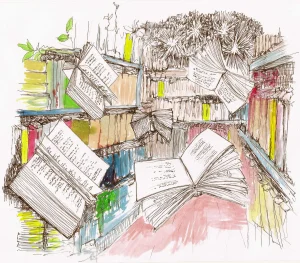
Educational platform developed by Professor Luc Bovens to support the teaching of ethics through literature. For the project, I designed the website and created a series of original illustrations to accompany the stories, helping communicate complex philosophical ideas through visual storytelling.
The illustrations were developed in response to the themes and cultural context of each story, providing a visual language that complemented the text while remaining sensitive to its setting. The project explored how illustration can support ethics education by making abstract concepts more engaging and accessible to students and educators.

Coping: A Philosophical Guide

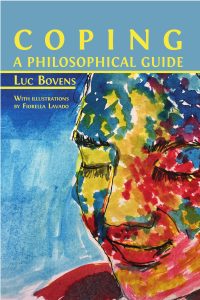
Coping: A Philosophical Guide is a collection of essays by Professor Luc Bovens exploring how philosophy can help us navigate the challenges of everyday life. Building on our previous collaboration, I created the illustrations for the publication, including the cover artwork.
Working closely with the author, each illustration was developed through discussions about the themes of the book, translating philosophical ideas into visual narratives. The artwork responds to subjects including hope, love, loss, gratitude, apology and personal change, encouraging readers to reflect on these concepts through both text and image.

Research

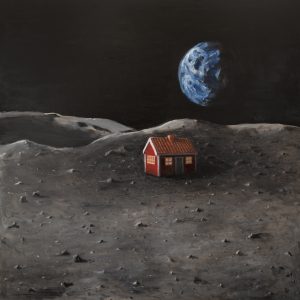
A visualisation of the small red house he intended to place on the Moon. Although the 2025 lander crashed during descent, the artwork now exists as vision and lunar debris, its imagined form preserved in this painting.

Space

I explore how the principles and ethics of heritage conservation might be applied beyond Earth. This research draws on a cross-disciplinary literature review and interviews with conservators, heritage researchers, engineers, curators, and specialists in space law and space heritage to propose a framework for making accountable conservation decisions where access, intervention and long-term stewardship are inherently limited. The first publication from this research, Towards a Conservation Framework for Space-Based Cultural Heritage Ensembles, will be presented at the 2026 IIC Congress in Ghent. Image credit: The Moonhouse, Michael Genberg.
History and Materiality

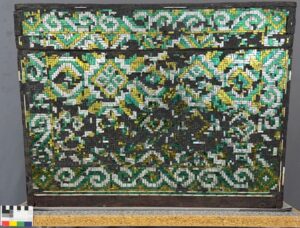
This research investigates how materials, repairs and later interventions shape the history and perceived authenticity of cultural objects. Using the conservation of a Siamese lacquered chest as a case study, it combined technical examination, treatment and historical research to explore how conservation decisions are informed by an object’s layered material history.
The research was presented in two conference papers: Preserving the Past, Shaping the Future: A Conservator’s Perspective on the Siamese Lacquered Chest at the What Is Furniture History? Symposium (University of Leeds, 2024), and Material Conflict and the Layers of Authenticity in the Conservation of a Siamese Lacquered Chest at the Ebenist Symposium (Rijksmuseum, Amsterdam, 2026).

Sustainable Materials

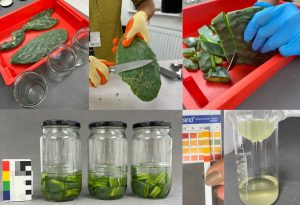
This research investigates the use of sustainable materials in conservation, with a focus on developing environmentally responsible alternatives to conventional treatments. A study of Opuntia ficus-indica mucilage as a consolidant for Reigate stone examined its performance through laboratory testing and practical application, contributing to ongoing discussions on sustainability in conservation practice.
The research was presented at Stone 2025, Sorbonne University, Paris, and published in the Stone 2025 Proceedings.

Ethics in Heritage Conservation

This research explores the ethical principles that inform conservation decision-making. Through work with archaeological collections, culturally significant objects and interdisciplinary collaborations, it examines questions of stewardship, authenticity, cultural sensitivity and the responsibilities of conservators towards both objects and the communities connected to them.
Research outputs include Collaborative Reparative Efforts to Address Lost Context and Misinterpretation: Conservation and Presentation of Pre-Hispanic Andean Textiles at the Krannert Art Museum, presented at the AIC Mending Threads conference (2025), and contributions to the Journal of the Institute of Conservation article Collaborative Cultural Recovery as Relational Care (2025).